
Golf Cart vs UTV: Which One Do YOU Need?!?
Golf carts and UTVs look similar parked side by side, but they solve very different problems. Here's how to pick the one that fits your property and budget.
Updated October 19, 2026
On this page
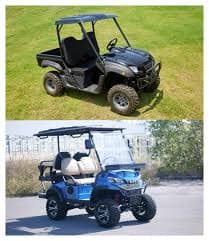
Park a golf cart next to a UTV and they can look like cousins — four wheels, a couple of seats, a small cargo area. But they're built around completely different assumptions, and buying the wrong one for your property is an expensive lesson. One is a comfortable, low-cost people-mover for smooth ground. The other is a rugged work-and-play machine for terrain that fights back.
Here's how to figure out which one actually makes sense for you.
What Each One Is Actually For
A golf cart is designed to move people and light loads across maintained surfaces — fairways, campgrounds, neighborhoods, large flat properties, event grounds. It prioritizes low cost, quiet operation, easy driving, and comfort. Most are electric, though gas models exist.
A UTV is built to work and play on rough ground — trails, hills, mud, snow, job sites. It prioritizes ground clearance, suspension travel, four-wheel drive, towing, and payload. It'll cross terrain a golf cart can't even approach.
The "lifted golf cart" blurs this line a bit — bigger tires, a lift kit, more clearance — and those are genuinely more capable than a standard cart. But even a lifted cart isn't a UTV. It's still a cart that can handle more, not a purpose-built off-road machine.
Cost: The Golf Cart's Big Advantage
If you're watching your budget, the golf cart usually wins. Both to buy and to own, carts tend to cost less:
- Purchase price is generally lower, new or used, than a comparable UTV.
- Maintenance is simpler and cheaper — especially on electric carts, which have far fewer moving parts than a gas UTV with a CVT, 4WD system, and suspension.
- Operating cost is low if it's electric: you're charging a battery, not buying fuel and belts.
A UTV costs more because you're paying for capability you may or may not need. That's the whole question — are you paying for capability you'll actually use?
Terrain: The UTV's Big Advantage
This is where the golf cart hits its limit fast. Standard carts have low ground clearance, minimal suspension, no 4WD, and small tires. On flat grass or gravel, that's all fine. Add hills, ruts, mud, or rocks and a standard cart struggles, gets stuck, or simply can't go.
A UTV is the opposite. Real suspension travel, high clearance, aggressive tires, and selectable four-wheel drive mean it goes where you point it. If your property has:
- Steep grades or hills
- Mud, creek crossings, or soft ground
- Rocky or rooted trails
- Snow in the winter
...then a golf cart will frustrate you and a UTV will shrug it off.
Hauling and Work
Golf carts can carry light loads — a cooler, some tools, a couple bags of mulch in a small bed. That's about it. They're not built to tow or haul anything serious.
UTVs are built for it. A real cargo bed with meaningful payload, plus genuine towing capacity, means a UTV can move firewood, feed, fence posts, equipment, or a small trailer. If "getting stuff done" is part of why you want a machine, the UTV is in a different league.
Street-Legality and Where You Can Drive
This one varies a lot by location, so check your local rules — but in broad strokes:
- Golf carts are often eligible for street-legal status in low-speed-vehicle zones, neighborhoods, and many communities. Lots of people use them as around-town runabouts.
- UTVs are increasingly street-legal in rural counties and certain states, but the rules are patchier and often require added equipment.
If your main use is buzzing around a neighborhood, campground, or planned community, the golf cart often fits the legal picture more easily.
Quick Comparison
| Factor | Golf Cart | UTV |
|---|---|---|
| Purchase & maintenance cost | Lower | Higher |
| Rough terrain ability | Limited | Excellent |
| Hauling & towing | Light loads only | Strong |
| Ride comfort on smooth ground | Excellent | Good |
| Best environment | Flat, maintained property | Trails, hills, work sites |
| Typical powertrain | Mostly electric | Mostly gas, some electric |
So Which One Makes More Sense?
It comes down to your land and your jobs.
Choose a golf cart if your property is mostly flat and well-maintained, your main need is moving people and light cargo short distances, you want the lowest cost to buy and run, and street-legal neighborhood use is part of the plan. For a lot of campgrounds, retirement communities, and tidy acreage, a cart is genuinely the smarter, cheaper choice — buying a UTV for that job is paying for capability that just sits unused.
Choose a UTV if your property has hills, mud, trails, or snow, you've got real hauling and towing to do, or you want a machine that doubles as recreation. The extra cost buys capability you'll lean on constantly.
There's no shame in either answer — the mistake is buying the rugged machine for the easy job, or the easy machine for the rugged job. When you've decided which direction fits, you can browse both golf carts and UTVs on Off Road Market and compare real listings to find one that matches your property and your budget.
Frequently Asked Questions
Keep Reading
How to Buy a Used Side-by-Side Without Getting Burned
A practical, no-nonsense checklist for buying a used UTV — what to inspect, what to test-drive, and the red flags that should make you walk away.
ATV vs UTV: Which Off-Road Vehicle Should You Buy?
ATVs and UTVs both get you off the pavement, but they're built for different riders. Here's how to figure out which one actually fits your life.
Best Off-Road Vehicles for Hunting, Farm Work, and Trail Riding
The best off-road vehicle depends entirely on the job. Here's what to look for if you hunt, work a property, or live for the trails.
Get off-road tips in your inbox
Buying guides, maintenance how-tos, and new listings — no spam, unsubscribe anytime.